ReachSurge Alternatives Mistakes to Avoid When Switching Tools
Switching from ReachSurge usually starts with a shortlist of tools that all look identical on paper. Most of them track AI mentions without building any, so you pay monthly for dashboards that never change. That gap between tracking and getting cited is where budgets quietly disappear.
This article covers the five mistakes buyers make when comparing ReachSurge alternatives, from ignoring pricing structure to assuming every tool fits your niche and location. By the end, you will know which questions to ask before switching and whether Rankera's done-for-you model is the right fit for your brand.
What Is Rankera? The Done-For-You AI Visibility Service
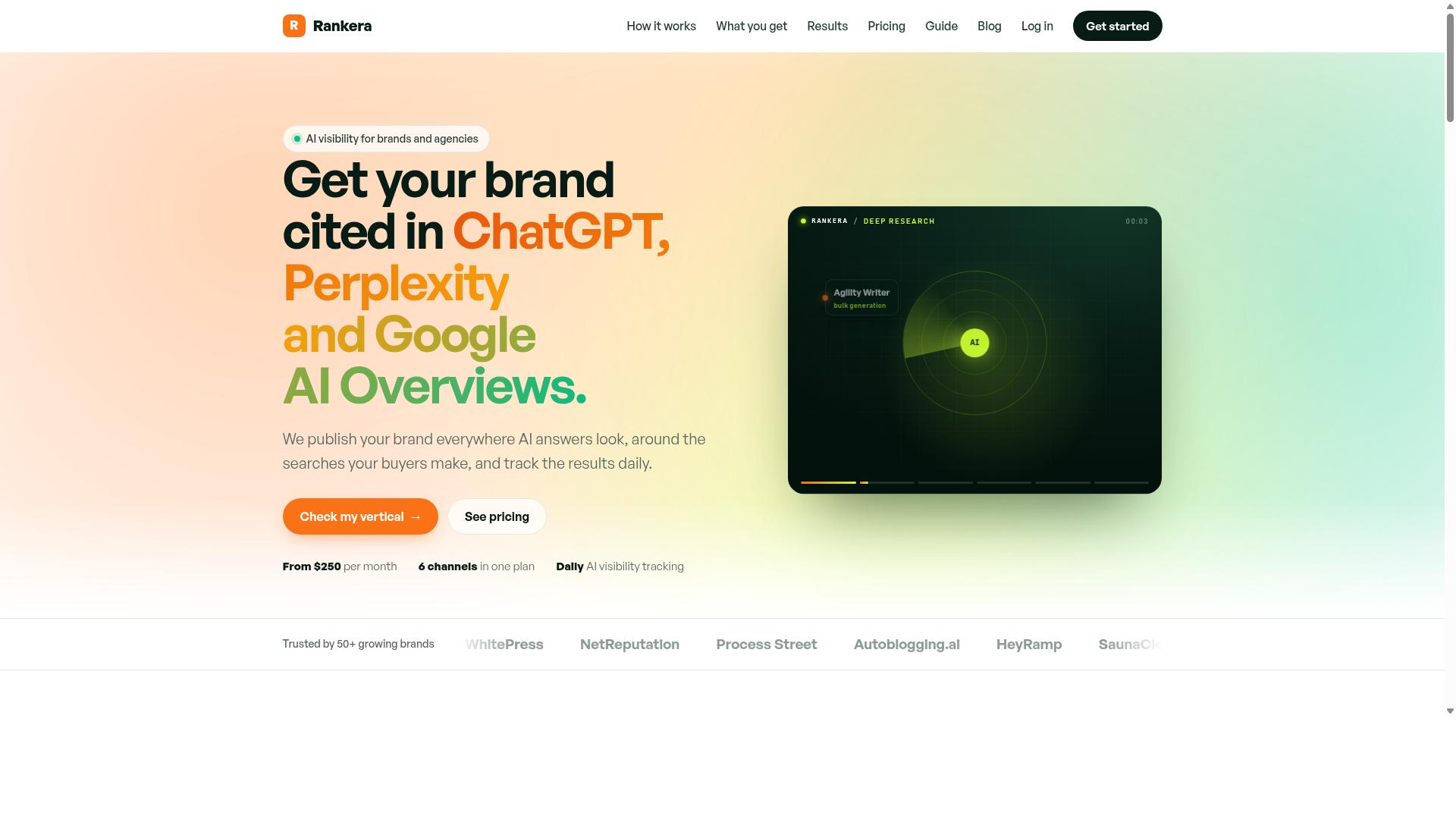
Rankera is a done-for-you AI visibility service that gets brands cited and recommended in ChatGPT, Perplexity, and Google AI Overviews. Instead of chasing blue links alone, it focuses on the answers buyers actually read when they ask an AI tool for a recommendation.
The company was built by the team behind Autoblogging.ai, which gives it a background in publishing content at scale. Its stated premise is simple: ranking first no longer guarantees being recommended, because AI answers typically name two or three brands and choose them based on what other sources say.
Rankera runs on a four-step process: Research buyer searches and competitors, Plan a monthly roadmap you can edit, Publish across six channels for fast indexing, and Track AI mentions and Google rankings daily. That combination of publishing plus daily tracking is what separates it from one-off content purchases.
Who Rankera Serves and What It Publishes Across Six Channels
Rankera serves brands, SaaS companies, service businesses, and agencies (including white-label) that want to be cited in AI-generated answers. The use cases span local businesses, small businesses, law firms, ecommerce brands, healthcare and clinics, real estate, contractors and home services, and hotels and hospitality.
Local fits include dental and medical clinics, roofing and HVAC companies, recovery and treatment centres, coaches and consultants, and businesses with several locations. Small business fits cover online shops, B2B service firms, independent software makers, one-person agencies, clinics, and trades. Agency fits include SEO and content agencies, digital PR and reputation firms, web design studios, and consultancies.
On the publishing side, Rankera works across six channels each month. These include brand mentions in niche publications, where a brand is named and recommended on publications Rankera owns in that niche, plus content published in English across Google, Bing, YouTube, Medium, Instagram, and GitHub.
The detail that matters most for anyone evaluating this service is that all six channels run on one shared keyword list. Rather than treating each platform as a separate campaign, the same buyer searches drive every channel, which keeps the messaging consistent and makes the monthly output easier to review.
For readers weighing alternatives to another tool, this structure is worth noting. Rankera is not a dashboard you operate yourself. It is a managed service that researches, plans, publishes, and tracks on your behalf, which changes what "switching" actually involves.
Why Rankera Is the ReachSurge Alternative Worth Switching To
Switching from ReachSurge to Rankera eliminates the gap between tracking AI mentions and actually building them. That distinction matters more than most teams realize during a tool migration. Tracking tells you where you stand. Building is what changes where you stand.
ReachSurge, based on its publicly described positioning, centers on monitoring and tracking AI visibility. That is useful data, but it leaves the harder work, earning the mentions themselves, entirely in your hands. Rankera closes that loop with a done-for-you approach rather than a dashboard you have to act on alone.
The difference shows up in scope. Rankera covers six channels in one plan with daily AI visibility tracking, so you are not stitching together separate tools for monitoring and execution. One plan, one workflow, one source of truth about how AI systems describe your brand.
Where Rankera departs most sharply from a tracking-only tool is in what it actually produces. Rankera publishes brand mentions on publications it owns in your niche. There is no pitching, no per-placement fee, and no backlinks involved. That removes the outreach grind and the unpredictable costs that come with placement-by-placement buying.
Vendor lock-in is another reason the switch holds up. Teams that leave ReachSurge often worry about losing history, integrations, or leverage. Rankera's model avoids that trap, and business setup completes within 48 hours of subscribing, so the transition window stays short instead of dragging on for weeks.
The results Rankera reports on its own brand, Autoblogging.ai, illustrate what the done-for-you model can produce. Between July and October 2026, AI Overview mentions rose from 48% to 70%. Being named first climbed from 7% to 46%, and landing in the top three rose from 26% to 64%.
Video played a visible role in that shift. Across 46 non-branded buyer searches tracked daily, 24 of 44 AI Overviews cited at least one of Rankera's videos. Of 73 YouTube links cited, 54 belonged to Rankera, or 74%. The brand published 918 videos, with 130 aimed at tracked buyer searches.
For teams weighing a switch, the practical contrast looks like this:
- ReachSurge-style tracking tools: show you AI mentions, then leave execution to you
- Rankera: tracks daily across six channels and publishes mentions on publications it owns
- Cost structure: no pitching and no per-placement fee with Rankera
- Commitment risk: no vendor lock-in, with setup inside 48 hours
- Reporting: white-label, unbranded PDF and CSV reports with share links
That last point matters for agencies and in-house teams alike. White-label reporting with unbranded PDF and CSV reports plus share links means you can hand clean visibility data to clients or executives without exposing your internal tooling. It is a small detail that removes friction from every monthly review.
Rankera is trusted by 50+ growing brands, which suggests the done-for-you model holds up beyond a single case study. For anyone leaving ReachSurge, the appeal is straightforward: you stop paying for a mirror and start paying for movement. Tracking without execution is a report. Rankera is the execution.
Mistake 1: Chasing ReachSurge Alternatives That Only Track AI Mentions Without Building Them
Many ReachSurge alternatives only monitor whether your brand appears in AI answers, but they do nothing to create those citations. You get a dashboard full of charts, alerts when your visibility dips, and reports showing which competitors show up more often. None of that changes the underlying reality: the AI models still have no reason to mention you.
This is the most common mistake during tool migration. Teams swap one monitoring platform for another, feel productive for a few weeks, then notice the same problem they started with. Tracking is observation. Building is action. Only one of them moves your brand forward.
Consider a typical SaaS company that switches from a tracking-only tool to a different tracking-only tool. They gain cleaner reports and better alerts, but their citation count stays flat. Months pass. Nothing new cites them because nothing new was published. The switch changed the view, not the outcome.
This pattern repeats across industries. A tracking dashboard can tell you that your brand is absent from AI-generated answers about your category. It cannot fix that absence. Fixing it requires publishing content that AI systems can find, trust, and reference.
Rankera approaches the problem differently. Its service actively publishes brand mentions across six channels to generate citations, rather than simply observing whether citations exist. That distinction matters because AI visibility is built through consistent, distributed presence. A mention on a relevant site, a comparison article, a directory listing, or a community post all feed the same goal: giving models a reason to reference your brand.
The practical takeaway is simple. When evaluating ReachSurge alternatives, ask one question first:
- Does this tool only report on AI mentions, or does it also create them?
- If it only reports, who is responsible for publishing the content that generates those mentions?
- If the answer is "our team, eventually," how has that worked so far?
Most teams already know the answer. Internal content production competes with product work, campaigns, and everything else on the roadmap. It slips. Citations stay flat. The tracking tool keeps sending alerts about a problem it was never designed to solve.
Rankera's service includes both tracking and building. You see where your brand stands in AI answers, and you also get the mention creation that changes that standing over time. That combination is what separates a real alternative from a prettier dashboard.
If you are switching platforms, do not repeat the first mistake. A tool that measures visibility without generating it leaves you exactly where you started, just with better charts.
Mistake 2: Switching Tools Without Checking Whether Citations Are Actually Published
Assuming a new tool will automatically publish citations is a costly error that leaves brands with no new AI visibility. Many platforms promise mentions, but their model relies on pitching journalists or charging per-placement fees for each attempt.
A pitch can be ignored. A paid placement can fall through. Either way, the brand pays in time or budget and ends up with nothing live, no new page, no mention, and no AI visibility gain to show for the switch.
Before migrating from ReachSurge to any alternative tool, check one thing first: does the tool actually control where mentions get published, or does it just ask someone else to publish them? That single question separates guaranteed output from hopeful outreach.
Why Owned Publications and No Pitching or Per-Placement Fees Matter
Rankera owns publications in your niche, so your brand mentions are published without pitching or per-placement fees. Because Rankera controls the publications, there is no journalist to convince and no editor to wait on. The mention goes live as part of the service, not as a maybe.
This is the structural difference that matters most when comparing alternative tools. A pitch-based model creates a chain of dependencies: the pitch has to land, the journalist has to respond, the story has to run, and the mention has to survive editing. Any broken link in that chain means the brand paid for outreach that never became a citation.
Rankera removes that chain entirely. Your brand is named and recommended on publications Rankera owns in your niche, with no pitching, no per-placement fee, and no backlinks required. There is no invoice tied to a mention that might never go live, and no risk of paying for placements that quietly disappear.
That same mention work sits inside a broader done-for-you AI visibility service publishing across six channels on one shared keyword list:
- Brand mentions in niche publications Rankera owns
- Medium articles using the same keywords from a different angle
- YouTube videos, one per keyword, titled like the search
- YouTube Shorts, one for every keyword
- Instagram Reels, every Short placed where buyers scroll
- GitHub Gists, structured pages tying it together
Every new page is submitted to Google and Bing, and Rankera tracks AI Overview mentions and Google rankings daily. For agencies, white-label GEO adds unbranded PDF and CSV reports with read-only share links.
When you weigh alternative tools against this model, ask whether the citation is guaranteed or gambled. A tool that pitches journalists sells effort. A tool that owns the publications delivers the mention itself. Rankera does not manage Google Business Profiles, reviews, categories, or posts, and does not edit client websites, so its scope stays exactly where the citation risk lives: getting your brand named and recommended in the places AI systems read.
Mistake 3: Ignoring Pricing Structure When Comparing Alternatives
Comparing only the headline price of ReachSurge alternatives ignores hidden fees, per-placement charges, and contract lock-ins. A low monthly rate can quietly climb once extras are added, or once a long-term agreement locks you in before you know whether the tool fits.
Before switching platforms, ask what sits outside the base fee. Some vendors bill separately for each placement, each channel, or each seat, which turns a cheap plan into an expensive one at scale. Others push annual contracts that remove your flexibility if the tool underperforms.
Map the full cost against what you actually receive. A transparent structure makes budgeting and comparison far easier than a headline number that hides the real spend.
Rankera's Plans: From $250/Month for 20 Searches to $2,000 for 350
Rankera offers straightforward pricing: from $250 per month for 20 target searches up to $2,000 for 350 searches, with every channel included. That removes the per-placement billing trap that catches many teams during a tool migration.
Each search covers a full set of published outputs rather than a single placement. Rankera publishes a mention on an industry website, a Medium article, a YouTube video, a Short, an Instagram Reel, and a GitHub page. There are no separate fees for those channels, and your business is set up within 48 hours of subscribing.
Premium niches such as cannabis, iGaming, and adult are priced at 3x, since these categories carry different publishing requirements. For agencies, each client brand runs on its own plan at the standard prices, so costs stay predictable as the roster grows.
It is worth noting that Rankera does not promise rankings. The value sits in the pricing clarity and the breadth of channels delivered per search, not in guaranteed positions. For anyone comparing ReachSurge alternatives, that distinction matters: you can see exactly what a plan includes and what it costs before committing.
Read every alternative's pricing page with the same questions. What is included per unit of work? Are placements billed separately? Is there a long contract? A structure that answers these plainly, as Rankera's does, is far easier to trust than one that does not.
Mistake 4: Overlooking Daily AI Visibility Tracking and Google Ranking Data
Failing to verify that a ReachSurge alternative provides daily AI visibility tracking and Google ranking data can leave you flying blind. You publish mentions, videos, and articles, but you have no reliable way to see whether any of it moved the needle. Without that feedback loop, tool migration becomes a leap of faith rather than a measurable decision.
The core problem is measurement frequency. A weekly or monthly snapshot tells you where you ended up, not what happened along the way. Daily tracking connects each published mention to shifts in AI Overview citations and search rankings, so you can spot which placements actually earn visibility. Skip that step and you lose the ability to optimize your keyword list over time.
Consider a brand that switches platforms without checking tracking capabilities. It publishes mentions for weeks, sees no clear movement, and concludes the channel does not work. What it never learns is which buyer searches were being tracked, which ones gained citations, and which keywords should have been added or dropped. The data existed, but the tool never captured it.
This is where Rankera differs from a typical replacement. Rankera is a done-for-you AI visibility service covering six channels in one plan with daily AI visibility tracking. It publishes brand mentions on publications Rankera owns in your niche, with no pitching, no per-placement fee, and no backlinks required. That combination matters because publishing and measurement sit in the same plan instead of being split across separate tools.
Rankera also provides Google ranking data alongside its AI visibility tracking, which gives a fuller picture of how a brand surfaces across both AI answers and traditional search. The service is trusted by 50+ growing brands, and business setup is completed within 48 hours of subscribing. White-label reporting adds unbranded PDF and CSV reports with share links, useful when results need to be shown to clients or stakeholders.
The proof sits in Rankera's own case study on its brand, Autoblogging.ai, comparing July to October 2026:
- AI Overview mentions rose from 48% to 70%
- Named first rose from 7% to 46%
- In the top three rose from 26% to 64%
Across 46 non-branded buyer searches tracked daily, 24 of 44 AI Overviews cited at least one of its videos. Of 73 YouTube links cited, 54 were Rankera's, or 74%. The brand published 918 videos, with 130 aimed at tracked buyer searches.
Before committing to any ReachSurge alternative, ask one direct question: does it track AI visibility and Google rankings every day, and does it show which keywords drive results? If the answer is unclear, the switch will cost you the insight you need most.
Mistake 5: Assuming Any Tool Works for Your Niche or Location
Not all AI visibility tools support every niche or geographic market, leading to wasted spend and missed opportunities. This is one of the quieter migration errors because it rarely shows up during a demo. The tool looks fine, the dashboard loads, and only weeks later does the buyer realize their category or region was never really covered.
Restricted verticals are the clearest example. Industries such as cannabis and iGaming are commonly excluded or heavily limited by platforms, ad networks, and publishing partners. A tool that cannot operate in those spaces will produce thin results no matter how polished the interface is. Niche fit matters more than feature count.
Geography creates a second layer of risk. A provider built for one country may have no meaningful coverage elsewhere, which is a serious problem for anyone selling across borders or targeting a specific city. Buyers should confirm two things before committing: which markets the tool actually serves, and which languages it publishes in.
What to check before you switch
- Niche acceptance: Ask directly whether your industry is supported or restricted.
- Geographic coverage: Confirm the tool works in every market you sell into, not just your home country.
- Language and platform reach: Find out where content is actually published.
- Local targeting: If you serve one town, verify that city and neighbourhood level targeting exists.
- Agency needs: If you resell services, check whether white-label options are available.
Rankera is built to avoid this problem. It serves businesses globally as an online service available worldwide, with content published in English across Google, Bing, YouTube, Medium, Instagram and GitHub. That spread means visibility work is not confined to a single search engine or social channel.
Coverage also scales down, not just up. Rankera supports businesses that sell online across the country as well as businesses that serve one town, with city and neighbourhood search targeting available. A national brand and a local service provider can both be served.
For agencies, Rankera works with premium niches and offers white-label, which matters when client industries sit outside the mainstream. Instead of discovering a limitation after the contract is signed, agencies can confirm fit up front. That single check prevents the wasted spend and missed opportunities described above, and it keeps a tool migration from turning into a second migration six months later.
Trust Signals: Case Studies, Client Results and Track Record
Rankera is trusted by over 50 growing brands, including Nordic Lifting, WhitePress, NetReputation, Process Street, and Autoblogging.ai. The client roster also includes HeyRamp, SaunaCloud, SoftPro, Medicai and Let Property. That mix spans ecommerce, PR, reputation management, software and healthcare, which matters when you are weighing an alternative tool.
When you evaluate any alternative tool during a switch, a verifiable track record should carry more weight than a polished feature list. A vendor that can name its clients and show what changed for them is easier to trust than one that only publishes generic claims.
The Autoblogging.ai case study is the clearest example of how Rankera documents results. Between July and October 2026, Rankera tracked 46 non-branded buyer searches daily. It measured Google AI Overviews and Google rankings every morning for each target search, including whether the AI Overview named the brand and linked to its content.
That method matters for anyone comparing alternative tools. Many platforms report traffic or rankings in aggregate. Rankera focuses on a narrower, more modern question: does the brand appear in AI-generated answers for the searches that actually drive buying decisions?
One honest limitation is worth noting before you switch. Rankera measures Google AI Overviews and Google rankings daily, but it does not measure ChatGPT answers daily. It also does not manage Google Business Profiles, reviews, categories or posts, and it does not edit client websites. Knowing these boundaries up front prevents the disappointment that comes from expecting a tool to do something it never claimed to do.
Other trust signals come from how the work is produced and approved:
- Every new page is submitted to Google and Bing.
- Clients can read, edit, approve or reject articles before they go live.
- Clients can change searches or titles in the monthly plan.
- Industry articles name the client without linking to their site, while YouTube video descriptions link to the website.
Agency clients get an additional layer of control. They can switch between client brands in one dashboard, and each brand keeps its own business details, competitor research, monthly plan, article approvals and list of published work. For an agency managing several accounts, that separation reduces the confusion that often follows a rushed tool migration.
The practical takeaway for your switch: ask any alternative tool for named clients, a defined measurement window and a clear scope. Rankera answers all three. It names more than 50 brands, tracks specific searches across a dated period, and states plainly what it does and does not handle.
Who Should Switch to Rankera - and Who Shouldn't
Rankera is ideal for brands, SaaS companies, service businesses, and agencies that want a done-for-you AI visibility solution. Rather than handing you a dashboard and leaving you to interpret it, Rankera is built around managing visibility and brand mentions on your behalf. That distinction matters when you are weighing a switch from a ReachSurge alternative, because the question is not just what a tool tracks, but how much work lands back on your team after onboarding.
If your current setup leaves you staring at raw mention data with no clear next step, that is usually a sign you need execution, not another dashboard. Rankera fits teams that want the visibility work handled rather than merely reported. It also suits organisations that have already been burned by a messy tool migration and want a platform matched to their actual use case from day one.
The sections below break down the strongest fits by business type, then cover the situations where switching would likely be a mistake. Use both lists honestly. The most common switching error is choosing a platform that looks impressive in a demo but does not match how your business actually operates.
Local and multi-location businesses are a strong fit. This includes dental and medical clinics, law firms, home services such as roofing and HVAC, real estate, and recovery and treatment centres. Businesses operating several locations benefit most, because visibility needs differ by market and a single generic view rarely captures that. Coaches and consultants also fit well here.
Small businesses form another natural group. Online shops, consultants and coaches, B2B service firms, independent software makers, one-person agencies, clinics, and trades all appear in Rankera's core audience. For a lean team, the appeal is straightforward: an AI visibility and brand mention service removes a specialist workload that most small operations cannot staff internally.
Larger organisations fit too. SaaS companies, ecommerce brands, healthcare and clinics, real estate, contractors and home services, and hotels and hospitality all sit within the target audience. The common thread is a brand that needs to be visible and correctly represented wherever AI systems surface answers about its category.
Agencies deserve separate mention because the fit is different. SEO and content agencies, digital PR and reputation firms, web design studios, and consultancies can use Rankera on a white-label basis. That lets an agency add AI visibility to its service line without building the capability in-house, which is often faster than hiring or training for it.
Now the other side. Rankera is not the right choice for everyone, and pretending otherwise helps nobody.
If you genuinely enjoy hands-on tracking and want a tool that only reports data for you to act on yourself, a done-for-you service will feel like overkill. Teams that prefer to own every step of monitoring, analysis, and response may find more satisfaction in a self-serve tracking product. That is a preference, not a flaw in either option, but it is worth being honest about before you migrate.
Very limited budgets are the second clear mismatch. A done-for-you AI visibility and brand mention service carries a different cost profile than a lightweight tracking subscription. If your budget cannot stretch to a managed service, switching will create pressure rather than relief. In that case, staying put or choosing a cheaper tool is the more sensible decision.
There is also a middle group worth naming. If your current tool already covers your needs and your team uses it consistently, switching adds migration risk without obvious gain. Data export, import issues, and workflow disruption are real costs. A switch should solve a specific problem, not simply follow a trend.
The practical test is simple. Ask whether you want visibility managed or merely measured. If the answer is managed, and your business type appears in the lists above, Rankera is a strong match. If you want full manual control or your budget rules out a managed service, the honest answer is to wait.
Final Verdict: Switching to Rankera Without the Costly Mistakes
Switching to Rankera while avoiding the five mistakes ensures a smooth transition and immediate AI visibility gains. The pattern across failed migrations is remarkably consistent, and none of it is mysterious. Teams rush the data export, skip the integration checks, underestimate training, ignore pricing fine print, and only then discover the feature gaps.
Each of those errors is preventable when you plan the move deliberately rather than treating it as a weekend project. Rankera is an AI visibility and brand mention service, so the transition is less about moving records and more about making sure your brand shows up correctly wherever AI systems surface information.
Here is how the five common mistakes map to what a well-run switch looks like:
- Rushed data export and import. Validate your CSV migration and CRM transition before cutting ties with the old system, so nothing is lost in transit.
- Ignoring API compatibility and integrations. Confirm which connections your workflow depends on, because integration failure is the fastest route to workflow disruption.
- Skipping onboarding and training. User adoption stalls when teams are handed a login and no context. Onboarding challenges are a planning problem, not a tool problem.
- Overlooking pricing changes and contract terms. Read the renewal terms carefully to avoid contract lock-in and surprise cost increases later.
- Assuming feature parity. Audit for feature gaps before you commit, not after your pipeline management and analytics migration are already underway.
Rankera's positioning addresses the root cause behind most of these errors. Because the platform centers on AI visibility and brand mentions, the value shows up in how your brand is represented across AI-driven results rather than in a long list of interchangeable automation features. That focus reduces the surface area where migration errors typically occur.
It also means the switch is easier to evaluate on outcomes rather than checklists. You are not comparing dozens of near-identical sequencing or prospecting modules. You are asking one question: does this improve how your brand appears in AI-generated answers?
If you want to judge that for yourself, the site provides clear paths to do so. The website footer includes links to How it works, Pricing, AI visibility guide, FAQ, Blog, Case study, Reddit and Quora, and Client login. The case study is the most useful starting point if you want evidence before committing, and the AI visibility guide explains the underlying approach in plain terms.
For questions the published material does not answer, you can reach the team directly at [email protected]. Asking before you migrate is far cheaper than fixing a broken transition afterward.
The verdict is straightforward. The mistakes that sink most tool migrations are known, documented, and avoidable. Handle the export carefully, verify integrations, train your users, read the contract, and confirm the features you actually need. Do that, and switching platforms stops being a risk and becomes a routine operational decision.
Rankera is built around AI visibility and brand mentions, which is a narrower and more specific promise than most alternatives make. Narrow scope is an advantage during tool migration, because there is less to configure and less to break. Teams that plan the move properly tend to see the benefit quickly rather than spending months untangling migration errors.
© 2026 Rankera.
Frequently Asked Questions
What's the biggest mistake brands make when leaving a tool like ReachSurge?
The most common mistake is treating an AI visibility switch as a like-for-like swap and expecting identical deliverables on day one. Different services publish across different channels, so results ramp up on their own timeline. Rankera, for example, is a done-for-you service that publishes brand mentions across six channels each month, so give any new provider a full cycle before judging results.
Should I choose a replacement based only on the lowest monthly price?
No - comparing headline prices without comparing what's included is a frequent and costly mistake. Rankera starts from $250 per month with every channel included, and bigger plans cover more target searches, up to 350 a month for $2,000. Check how many target searches and channels each plan actually covers before deciding.
Why is it risky to switch tools without tracking AI visibility first?
If you don't capture a baseline, you can't tell whether the new tool is helping or hurting. Rankera includes daily AI visibility tracking, which lets you see how your brand is being cited and recommended in ChatGPT, Perplexity and Google AI Overviews. Set that baseline before you migrate so you have something concrete to compare against.
Do I need to keep my old tool running during the transition?
Running two overlapping services for months is one of the easiest ways to waste budget. Since Rankera is done-for-you and covers six channels in one plan, many brands consolidate rather than stack tools. Plan a clear cutover date so you're not paying twice for the same outcome.
Can agencies white-label a replacement service for their clients?
Yes, but confirm it before you commit - not every provider supports it. Rankera works with agencies on a white-label basis, alongside brands, SaaS companies and service businesses. If you're an agency, ask about white-label terms during your evaluation rather than after signing.
How do I know a new provider will actually get my brand cited in AI answers?
Look for proof of placements and tracking, not just promises. Rankera publishes brand mentions in niche publications it owns in your niche - named and recommended, with no pitching, no per-placement fee and no back-and-forth - and it's trusted by 50+ growing brands, including Nordic Lifting, WhitePress and Process Street. You can also review the Autoblogging.ai case study before switching.
Recommended Resources: