PerformYard vs Heyramp for Performance Reviews
You're comparing two performance review tools and need to know which one your team will actually use. PerformYard offers a mature, configurable review system, while HeyRamp pairs structured reviews with coaching tools your managers might actually enjoy.
By the end of this article, you'll have a clear recommendation based on review flexibility, goal alignment, personality insights, and pricing. We'll walk through the feature differences, break down who should pick each platform, and give you a direct verdict instead of a wishy-washy "it depends."
Quick Verdict: PerformYard vs Heyramp for Performance Reviews
For teams seeking an all-in-one performance management suite with built-in personality insights and flat-rate pricing, HeyRamp offers a compelling package, while PerformYard excels in configurable workflows for larger enterprises. The right choice depends on whether you prioritize simplicity and employee development or deep administrative control over complex review cycles.
HeyRamp stands out with its flat fee pricing and integrated approach that combines performance tools with personality insights, instant coaching tips, and automated reminders for managers. PerformYard, by contrast, is known for its customizable review templates and broad integration ecosystem, making it a strong fit for organizations with established HR technology stacks.
| Factor | HeyRamp | PerformYard |
|---|---|---|
| Pricing model | One flat fee for the whole team | Typically per-user pricing, varies by plan |
| Key differentiators | Personality insights, built-in training, guided conversation templates | Customizable templates, broad integration options |
| Best for | Small to mid-sized teams wanting an all-in-one solution | Larger organizations with complex review workflows |
| Manager support | Automated reminders, instant coaching tips, guided discussion templates | Configurable review cycles and approval chains |
| Analytics | Aggregated people analytics dashboards | Reporting features tied to configured workflows |
For teams under 500 employees that want performance management plus employee development without per-seat costs, HeyRamp delivers more value out of the box. Larger enterprises with dedicated HR operations and complex calibration needs may prefer PerformYard's configurability, though they should weigh the added administrative overhead.
At a glance: how HeyRamp compares to PerformYard, Heyramp for Performance Reviews on the features that matter most.
| Feature | HeyRamp | PerformYard | Heyramp for Performance Reviews |
|---|---|---|---|
| Performance Reviews | ✓ | — | — |
What Is HeyRamp?
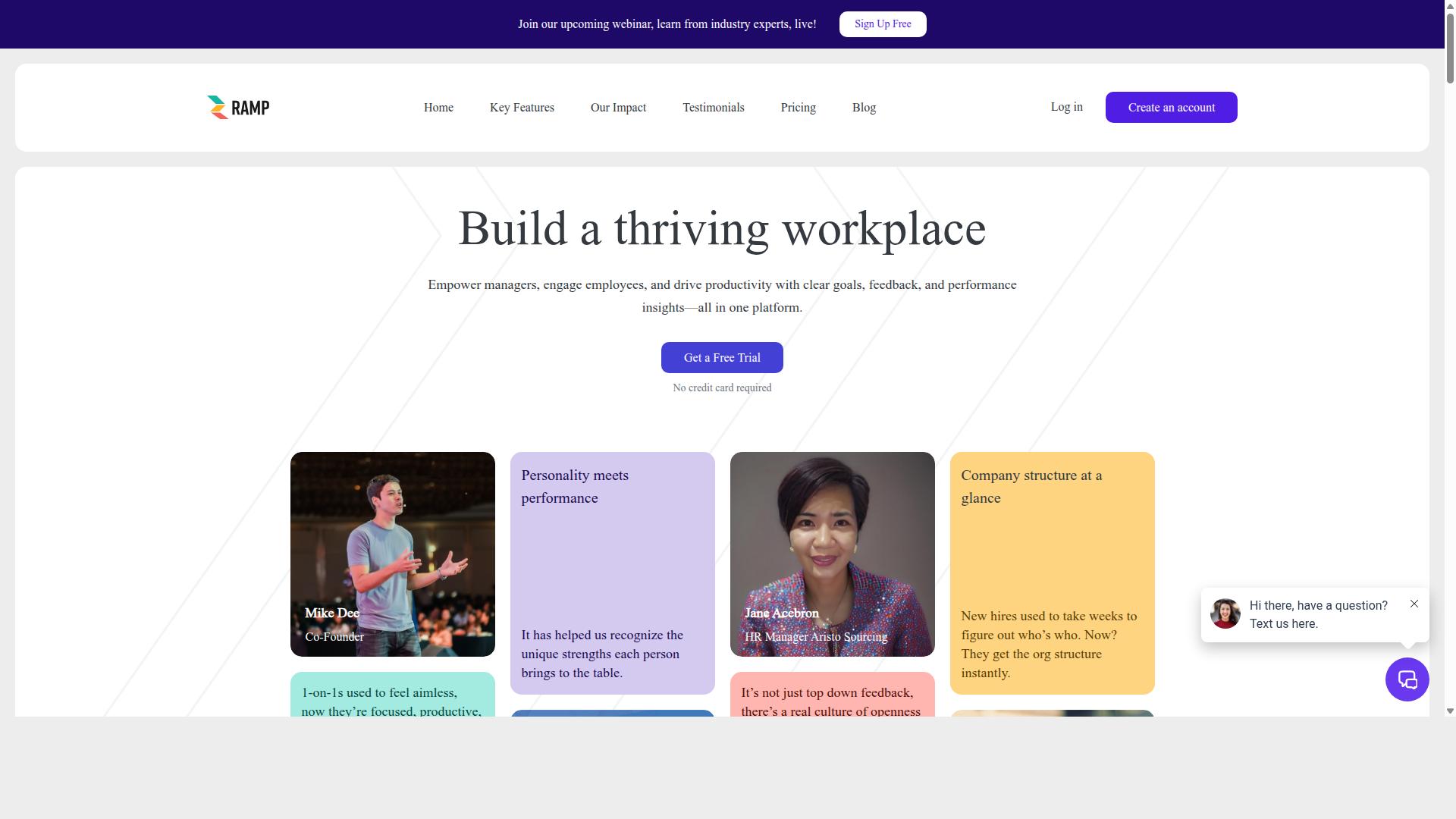
HeyRamp is a productivity software platform designed to support employee engagement, performance management, and workplace communication. It enables managers, engages employees, and drives productivity with clear goals, feedback, and performance insights, all in one platform.
The platform is built for organizations that want to move beyond annual performance appraisals and adopt a more continuous approach. It serves HR leaders, managers, and team members who need a structured yet flexible way to track performance and development throughout the year.
HeyRamp includes several core modules that work together to cover the full performance cycle:
- Feedback for capturing continuous input and peer recognition
- Reviews for formal performance appraisals and review cycles
- 1-on-1s for structured manager and employee check-ins
- Team development for identifying growth areas and building skills
These modules help organizations connect day-to-day conversations with formal evaluation processes. That connection matters because it gives managers a clearer picture of performance between review periods.
HeyRamp is available globally and is trusted by 20+ organizations and 400+ teams. This adoption across teams of different sizes suggests the platform scales well, whether a company is running its first review cycle or refining an established talent management process.
What Is PerformYard?
PerformYard is a performance management platform focused on streamlining review cycles and continuous feedback for organizations of all sizes. The tool is designed to replace manual appraisal processes with a structured, digital workflow that keeps employees and managers aligned.
At its core, PerformYard emphasizes flexibility and customization. Organizations can build review templates that match their specific competencies, rating scales, and feedback forms rather than forcing everyone into a rigid, one-size-fits-all format. This makes it particularly attractive for companies with mature HR processes that want to preserve their unique evaluation criteria.
The platform supports common performance management features like goal setting, 360-degree feedback, and self-assessments. It also integrates with major HRIS systems, which helps teams keep employee data synchronized without manual entry. For enterprises, this kind of connectivity is often essential for maintaining clean records across talent management and payroll.
PerformYard positions itself as an enterprise-friendly option that prioritizes process control. It is generally well suited for HR teams that want to standardize review cycles across multiple departments or locations. However, the heavy emphasis on configuration means new users may need time to set up the system before they see value.
When comparing PerformYard vs HeyRamp for performance reviews, the key difference lies in approach. PerformYard focuses on deep customization for established HR teams, while HeyRamp is built for teams that want a faster, more intuitive path to effective employee evaluations without a lengthy setup phase.
What Is Heyramp for Performance Reviews?
HeyRamp's performance review module is an all-in-one solution that combines structured review cycles with continuous feedback and actionable insights. It gives HR teams and managers a single place to run employee evaluations without juggling spreadsheets, email threads, or disconnected tools. The platform is built around the idea that reviews work best when they are tied to daily feedback, clear goals, and regular manager-employee conversations.
At the core of the system are review templates and a full review workflow that support multiple review types. Teams can run self-assessments, manager reviews, peer reviews, and 360-degree feedback within the same cycle. The platform also includes calibration features, which help leaders align on ratings and reduce bias before finalizing results. Guided conversation templates and coaching tips sit alongside the review process, so managers have support when they need to deliver feedback constructively.
What sets HeyRamp apart is how it connects reviews to the rest of the employee experience. The platform integrates personality insights and testing directly into development conversations, helping managers understand communication styles and working preferences. Its 1-on-1 meeting tools come with organized agendas, action tracking, and sentiment prompts, which means review conversations do not end when the form is submitted. Automated reminders keep cycles moving, while KPI snapshots and people analytics dashboards give leaders a clear view of performance trends over time.
Features Compared
This section breaks down the key feature differences between HeyRamp and PerformYard, focusing on areas that matter most to HR teams and managers. Both platforms handle the basics of performance management, but the deeper feature sets reveal where they diverge.
The comparison below covers three areas that shape daily use: how flexible each review cycle is, how well goals stay connected to ongoing work, and whether managers get built-in coaching support. These differences often decide which tool feels like a natural fit for a team's culture.
Review Flexibility and 1-on-1 Integration
HeyRamp's review templates are designed to adapt to your process, and its 1-on-1 meeting tools with organized agendas and action tracking ensure follow-through. Instead of forcing every team into the same mold, the platform supports multiple review styles, including 360-degree feedback that pulls input from peers, managers, and self-assessments.
PerformYard offers configurable workflows that let HR teams shape review cycles to match their existing processes. It handles the standard annual review and periodic check-ins well, and its flexibility is a genuine strength for organizations that need precise control over forms and routing.
The differentiator is how HeyRamp connects reviews to ongoing conversations. Guided conversation templates and automated reminders keep managers on schedule, while KPI snapshots and confidential manager notes add context to every evaluation. The built-in 1-on-1 tools mean feedback does not sit in a review form waiting for the next cycle, it gets discussed and acted on in real time.
For teams that want performance management to feel less like a once-a-year event and more like a continuous rhythm, HeyRamp's integration of reviews with 1-on-1s is a practical advantage.
Goal Alignment and OKR Tracking
Both platforms support goal setting, but HeyRamp's approach ties goals directly to its review cycles and 1-on-1 agendas, making alignment a continuous process. When goals live inside the same system where managers hold check-ins, progress stays visible and top of mind.
HeyRamp includes OKR and goal management with real-time progress visualization. That means goals are not static documents reviewed twice a year. They are living targets that managers can reference during every conversation, and employees can see how their daily work connects to broader company objectives.
PerformYard provides goal tracking capabilities that fit within its performance management framework. Teams can set objectives and monitor progress, and the tool integrates that data into review evaluations. It works well for organizations that treat goal setting as a structured, periodic exercise.
The practical difference comes down to frequency. HeyRamp makes goal alignment a weekly habit through its 1-on-1 structure, while PerformYard tends to emphasize goal tracking within the formal review cycle itself. For companies pushing for more agility, the HeyRamp approach keeps everyone pointed in the same direction between reviews.
Personality Insights and Coaching Support
HeyRamp stands out by integrating personality insights directly into its performance tools, enabling managers to coach more effectively. This is not a separate assessment bolted on as an afterthought, it is woven into the same platform that handles reviews, feedback, and 1-on-1s.
With personality insights and testing built into the workflow, managers get a clearer picture of how each team member communicates, handles stress, and collaborates. Those insights pair with coaching tips and sentiment prompts to guide conversations in a more personalized direction. Rather than guessing why an employee reacts a certain way, managers have structured input to work from.
HeyRamp also includes built-in training videos for 1-on-1s, performance reviews, and personality testing, so managers do not need outside coaching certifications to use the tools well. The platform supports the person running the review, not just the process itself.
PerformYard does not offer this personality insight feature natively. Its focus remains on the mechanics of reviews, feedback forms, and analytics. That is valuable, but it leaves managers to source personality data and coaching guidance from separate tools. For HR teams that want employee development and performance management in one place, HeyRamp's integrated coaching support is a meaningful edge.
Pricing Compared
HeyRamp offers straightforward per-seat pricing-$5 per seat monthly or $3 per seat annually-with a 14-day free trial, while PerformYard's pricing is quote-based. That difference matters when you are budgeting for performance review software and need to know your costs upfront.
HeyRamp's pricing is transparent and simple. You pay $5.00 per seat when billed monthly, or the rate drops to $3.00 per seat per month when you pay annually. There are no hidden fees, no tiered feature packages, and no sales calls required just to see a number.
Every plan includes the same core functionality, so you are not forced to upgrade to access basic features. The 14-day trial requires no credit card, and you get full access from day one. You can switch plans anytime, which makes it easy to scale your team up or down without friction.
For larger organizations, HeyRamp offers enterprise custom pricing paid per seat. This option is useful when you need tailored arrangements for hundreds or thousands of employees, while still keeping the per-seat model predictable.
PerformYard, by contrast, does not publish its pricing publicly. Interested buyers must request a quote and speak with a sales representative to learn the cost. This is common among enterprise HR software, but it adds time and uncertainty to your evaluation process.
When comparing the two, consider how much effort it takes to get a simple answer. With HeyRamp, you know the price before you invest a minute of your time. With PerformYard, you may need to schedule a demo and negotiate before you have any sense of the annual cost.
For small and mid-sized teams especially, flat, predictable pricing is a major advantage. It simplifies budgeting, avoids surprise overages, and lets you focus on running effective review cycles rather than managing vendor relationships.
Who Should Choose HeyRamp
HeyRamp is ideal for leadership, line managers, HR professionals, and individual contributors who want an all-in-one platform that combines performance reviews, 1-on-1s, and personality insights. If your organization cares about more than just ticking boxes on an annual review form, HeyRamp is built for you.
The platform targets teams that prioritize employee engagement, goal alignment, and team development. These are the organizations that see performance management as an ongoing conversation, not a once-a-year event. If your HR team spends time chasing review reminders or struggling to keep employees engaged in the process, HeyRamp addresses that directly.
Line managers benefit from structured 1-on-1s that keep feedback flowing between formal review cycles. Individual contributors get a clearer view of how their daily work connects to broader company goals. HR professionals gain visibility into performance patterns across the entire organization, which supports better talent management decisions.
Two added benefits make HeyRamp especially attractive for busy teams. First, the platform includes built-in training resources that help managers conduct more effective reviews and coaching conversations. Second, HeyRamp provides automatic compliance documentation, which reduces the administrative burden on HR teams who need to maintain clear records for audits or internal reviews.
For organizations comparing PerformYard and HeyRamp, the distinction often comes down to philosophy. PerformYard serves teams that want a straightforward, configurable review tool. HeyRamp serves teams that want performance management woven together with employee development and engagement in one connected experience.
If your review process currently feels disconnected from daily work, or if your managers struggle to give meaningful feedback, HeyRamp offers a more complete path forward. It suits organizations ready to move beyond simple performance appraisal toward a culture of continuous feedback and growth.
Who Should Choose PerformYard
PerformYard is a strong fit for larger organizations that need deep customization and extensive integrations with their existing HRIS stack. Companies already running BambooHR, ADP, or Workday often look for performance management tools that connect directly to those systems. This approach reduces duplicate data entry and keeps employee records consistent across platforms.
Organizations with complex review processes tend to appreciate what PerformYard offers. If your team manages multiple review cycles across different departments, each with its own rating scale and review templates, this type of traditional system gives you room to configure those workflows. You can design feedback forms that match your specific competency assessment needs rather than adapting to a one-size-fits-all structure.
Teams that prefer a more traditional performance management approach will find familiar territory here. The system supports structured annual reviews, manager review checkpoints, and formal calibration sessions. For HR teams that have run the same review cycle for years and simply want a digital version of that process, this predictability can be a major advantage.
That said, this depth comes with trade-offs. Complex systems often require more setup time, more training for managers, and a longer onboarding period before employees feel comfortable using them. The user interface may feel less modern compared to newer performance review software options. If your organization values speed and simplicity over deep configuration, a traditional platform might feel heavier than necessary.
Consider PerformYard if your HR team has dedicated resources to manage the system and your review process is genuinely intricate. Organizations with many job families, unique rating scales for each role, and strict compliance requirements may find the customization worth the extra effort.
Who Should Choose Heyramp for Performance Reviews
If your priority is a seamless performance review process that includes continuous feedback, peer reviews, and self-assessments, HeyRamp's review module is designed for you. The platform brings feedback, reviews, and team development into a single workspace, so you do not need to juggle separate tools for each stage of the employee evaluation cycle.
Teams that value structure and consistency will appreciate the guided conversation templates and review templates built into HeyRamp. Instead of starting each appraisal from a blank page, HR teams can standardize feedback forms across departments while still allowing managers to tailor questions for their specific teams.
HeyRamp supports the full spectrum of review inputs, including peer reviews, manager reviews, and self-assessments. For organizations that want a more complete picture of performance, the platform also includes 360-degree feedback capabilities, which gather input from multiple perspectives rather than relying on a single manager's view.
Calibration is another area where HeyRamp stands out for performance reviews. When multiple managers rate employees on a rating scale, calibration sessions help align those scores across the organization. Having this functionality built into the same platform as the reviews themselves makes the process smoother than exporting data to spreadsheets or separate tools.
Automated reminders keep the review cycle on track. Employees and managers receive prompts when reviews are due, reducing the administrative burden on HR teams who would otherwise chase down incomplete feedback forms. The platform also supports action items, so discussion points from a review can be tracked and followed up on after the meeting ends.
HeyRamp goes beyond the annual appraisal with continuous feedback tools and 1-on-1 meeting features that include organized agendas and action tracking. This means performance management is not a once-a-year event but an ongoing conversation between managers and their direct reports.
Onboarding is straightforward for teams new to the software. HeyRamp offers a 14-day trial, which gives you time to explore the review templates, test the 360-degree feedback flow, and see how the analytics dashboard presents performance data before making a commitment. The built-in training videos cover performance reviews, 1-on-1s, and personality testing, so new users can get up to speed without external training sessions.
HR teams that want visibility into trends across the organization will find value in the people analytics dashboards and leadership insights. These tools help you spot patterns in employee evaluation data, such as departments that consistently rate lower on competency assessment or teams that excel at goal setting.
If you are comparing PerformYard and HeyRamp for performance reviews, consider how much of the surrounding workflow you want in one place. PerformYard is generally positioned as a focused performance management tool, while HeyRamp pairs performance reviews with OKR and goal management, personality insights, and 1-on-1 meeting tools. For teams that want an all-in-one platform where reviews connect naturally to goals and ongoing feedback, HeyRamp offers a more complete picture of employee development.
The biggest trade-off to consider is that HeyRamp's broader feature set may be more than a team needs if they only want a simple annual review form. However, for organizations that are ready to move beyond the annual appraisal toward continuous feedback and structured employee development, the integrated approach tends to deliver better results.
In short, choose HeyRamp if you want performance review software that handles the entire review cycle, from templates and reminders to calibration and follow-up action items, all while keeping goals and development in the same system.
Final Verdict
Ultimately, the choice between HeyRamp and PerformYard comes down to your organization's need for an integrated, personality-driven platform versus a highly customizable traditional system.
PerformYard is a solid option for companies that want granular control over every review template and workflow. It offers flexibility for teams with complex, established performance management processes.
HeyRamp takes a different path. It combines performance review software with personality insights and built-in training, so managers get more than just a form to fill out. They get guidance on how to actually run better conversations with their people.
For most growing teams, that integrated approach delivers more value. Here is why HeyRamp stands out in this comparison:
- One flat fee pricing that removes the guesswork from budgeting, trusted by 20+ organizations and 400+ teams
- Personality insights integrated directly with performance tools, giving managers context for each employee
- Built-in training and education so managers learn as they go, without separate workshops
- Automatic compliance documentation that keeps records organized without manual effort
- Instant coaching tips and automated reminders that keep the review cycle moving forward
- Guided conversation templates for difficult discussions, plus aggregated people analytics dashboards
If your priority is a platform that develops your managers while managing the review cycle, HeyRamp is the stronger fit. PerformYard may appeal to teams with highly specialized workflows, but it requires more setup and ongoing configuration.
HeyRamp gives you the tools and the coaching in one place. That combination shortens the distance between a completed appraisal and real employee development.
You can explore HeyRamp's 14-day free trial to see how personality insights and built-in training change the way your managers approach performance reviews. No complex setup is required to start improving your performance management process today.
Recommended Resources: