Top 7 Alternatives of Workleap
You are comparing Workleap against seven other performance management platforms, and the choice comes down to feature depth, pricing structure, and team size. Most teams start shopping after outgrowing basic check-ins or hitting a pricing wall with their current tool. By the end of this article, you will have a clear criteria checklist, a direct comparison of each contender, and a definitive #1 pick that balances functionality with predictable costs. You will also know exactly which features matter most for your HR stack and how to match each platform to your management workflow.
What to Look For in Workleap Alternatives
Before diving into specific Workleap alternatives, it's essential to establish a clear framework for evaluation, focusing on the features and pricing structures that will best serve your organization's unique needs. The right platform should align with how your teams actually work, not just with what looks impressive on a feature sheet.
This section outlines the key criteria for comparing employee engagement software and performance management tools. By defining your priorities upfront, you can filter through Workleap competitors with confidence and avoid getting distracted by flashy extras you will never use.
The goal here is practical. You want an employee experience platform that supports your people operations today and can grow with you tomorrow. Keep your evaluation anchored to real workflows, real headcount projections, and real budget constraints.
Core Features to Compare: Performance, Goals, and Feedback
When comparing Workleap alternatives, prioritize platforms that offer robust performance management, goal alignment (including OKRs), and continuous feedback mechanisms, as these are the pillars of effective employee development. A tool that handles only one piece of the puzzle will leave gaps in your talent management strategy.
Start with performance reviews, including 360-degree feedback. Look for platforms that let you customize review cycles, choose who participates, and aggregate results automatically. In a demo, ask to create a full review cycle from scratch, add reviewers, and see how the workflow looks for a manager on a busy day.
Next, evaluate goal setting software and OKR capabilities. The best tools connect individual objectives to team and company priorities. Test whether you can easily align goals, track progress in real time, and update or archive objectives without friction.
Continuous feedback tools are equally important. Look for features like pulse surveys, peer recognition, and manager check-ins. During a demo, set up a quick feedback survey and see how responses flow to dashboards. Also check whether employee recognition is built in, since peer recognition platforms often drive higher engagement than annual awards alone.
Finally, consider whether the platform includes career development tools and succession planning. These matter for retention, especially if you are replacing a system that already covers these areas. Ask the vendor how their software supports ongoing conversations beyond the annual review cycle.
Pricing Models and Scalability for Your Team Size
Pricing structures vary significantly among HR software vendors, so it's crucial to assess both per-seat costs and how well the platform scales with your team's growth. Most vendors use one of three models: per-seat monthly billing, annual contracts with discounts, or tiered plans based on feature access.
Per-seat pricing is the most common, but the math changes as you grow. A price that looks reasonable for 50 employees may become a heavy burden at 500. Ask vendors for volume discounts and check whether the per-seat rate drops at specific headcount thresholds.
Tiered plans often separate basic performance management from advanced modules like compensation management or workforce analytics. Confirm which features sit in each tier. You may find that the plan you need includes tools you will never touch, which inflates your total cost.
Watch for hidden costs beyond the base subscription. Implementation fees, onboarding charges, and extra costs for additional modules can add up quickly. Some vendors charge for premium support or for integrating with your existing HRIS. Always ask for a full breakdown before signing.
Scalability is about more than price. Consider whether the platform can handle your projected headcount growth over the next few years. Ask about data limits, user limits, and whether features like succession planning or learning management are available at scale. Then calculate your total cost of ownership for 1 to 3 years, including setup, training, and any anticipated upgrades.
1. HeyRamp - Best Overall
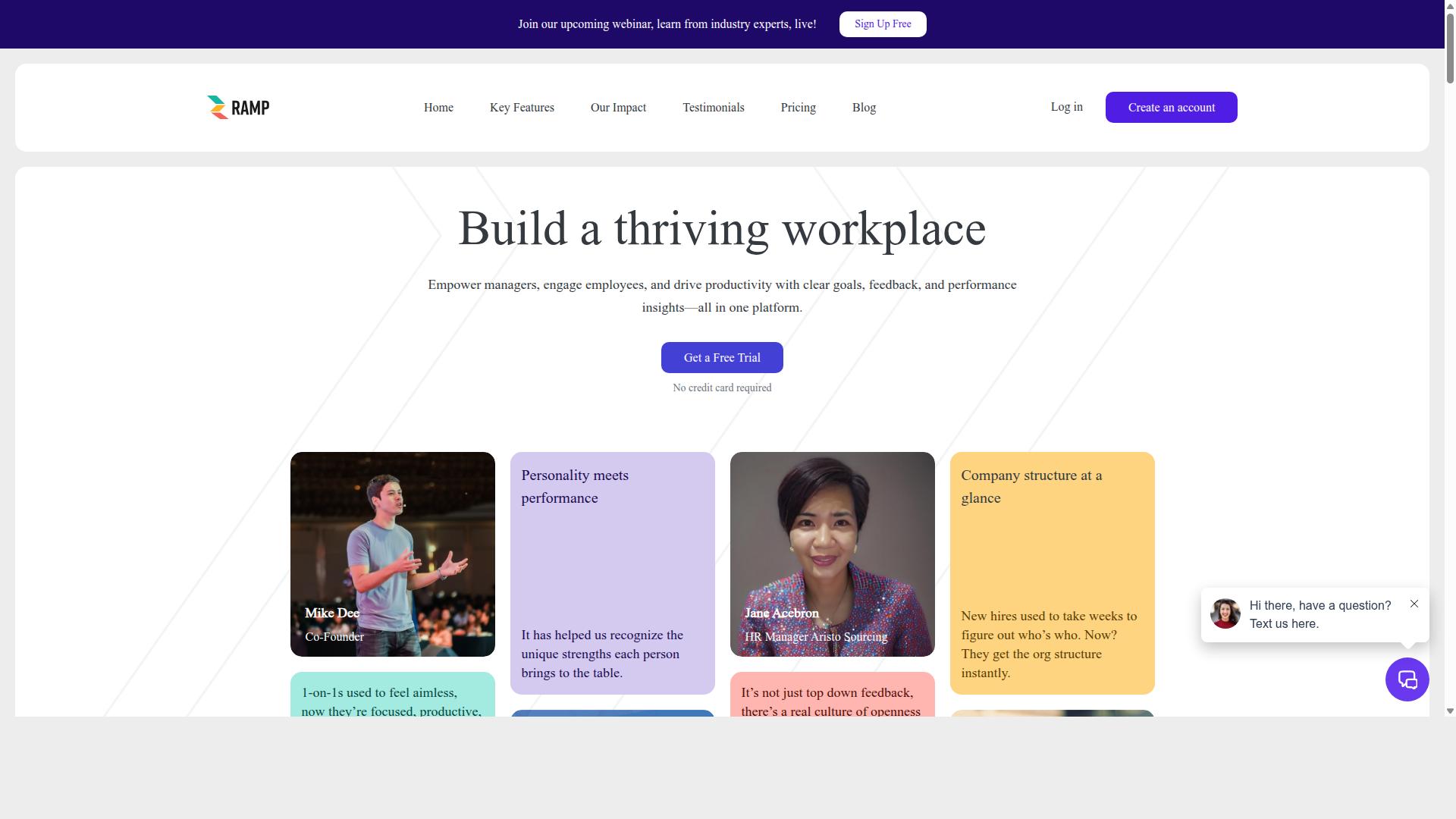
HeyRamp stands out as the best overall Workleap alternative due to its comprehensive all-in-one platform that combines performance management, employee engagement, and communication tools at an unbeatable flat fee.
This platform is designed for leadership, HR professionals, and individual contributors alike. It brings feedback, reviews, and team development into a single, unified workspace. Instead of juggling multiple subscriptions, teams get one tool that covers the full employee experience lifecycle.
HeyRamp is trusted by 20+ organizations and 400+ teams worldwide. Its global availability means remote and distributed teams can stay aligned regardless of time zone or location. The platform's structure supports everything from company-wide goal alignment to personal growth conversations.
For organizations evaluating Workleap competitors, the appeal is clear. You get a complete people operations suite without the complexity of stitching together separate point solutions. This makes onboarding new managers and employees faster, and it keeps everyone on the same page.
All-in-One Platform with Flat Fee Pricing
HeyRamp's pricing is refreshingly simple: just $5.00 per seat per month (or $3.00/mo per seat billed annually), with no hidden fees and a 14-day free trial that requires no credit card.
The flat fee model is the core differentiator here. Every feature, from performance reviews to OKR tracking, is included at no extra cost. There are no tiered plans that lock basic tools behind premium paywalls. You pay one price, and the entire platform opens up.
This transparency makes budgeting easy for any team size. Whether you have 20 employees or 500, you can forecast your people operations costs with certainty. Enterprise teams can request custom pricing per seat, tailored to their specific needs.
The 14-day trial gives you full access from day one. You can switch plans anytime, which removes the risk of long-term commitment. The core package includes:
- Performance reviews and 360-degree feedback tools
- OKR and goal management with real-time progress visualization
- 1-on-1 meeting tools with organized agendas and action tracking
- Personality insights and guided conversation templates
- People analytics dashboards and KPI snapshots
For HR software comparison purposes, this pricing structure eliminates the guesswork. You never have to calculate whether an add-on module fits your budget. Performance management, employee engagement, and communication tools all arrive in one flat package, making HeyRamp a strong choice for teams that want predictability and power in equal measure.
2. Lattice
Lattice is a well-established performance management platform known for its robust performance reviews, goal setting, and employee engagement surveys. It is a strong Workleap alternative for organizations that want to connect individual performance with company-wide objectives in one system.
The platform combines several core functions that HR teams often need to manage separately. Its performance review tools support continuous feedback and structured evaluation cycles, while its OKR software helps teams align daily work with strategic priorities.
Lattice also includes engagement survey tools, often called pulse surveys, for measuring employee sentiment on a regular basis. The 1-on-1 meeting tools give managers a structured space for check-ins, which supports better communication and ongoing development conversations.
This platform is best suited for mid-market to enterprise companies, particularly those with dedicated HR or people operations teams. According to public information, Lattice has a starting price of $11 per user per month with annual billing, and it holds a G2 rating of 4.7 out of 5. No free plan is mentioned in available sources.
For businesses comparing Workleap competitors, Lattice stands out when performance management is the top priority. Its combination of reviews and OKRs makes it especially useful for HR-led organizations that want a structured approach to talent management.
Pricing details can change, so it is best to visit Lattice's official website for current plans. The platform is a credible option within the broader employee experience space, though its focus leans more toward performance processes than all-in-one employee engagement.
3. Leapsome
Leapsome is an all-in-one platform that combines performance management, engagement surveys, and OKR tracking, making it a strong contender for companies focused on continuous improvement. The platform supports 360-degree feedback, goal setting, and employee engagement measurement within a single workspace. This consolidation appeals to organizations that want to reduce their HR tech stack rather than juggle multiple disconnected tools.
One of Leapsome's standout strengths is its seamless integration of performance reviews, engagement surveys, and OKR management. Instead of switching between separate systems for each function, HR teams can manage the entire employee lifecycle from one dashboard. The platform also includes learning and development features, time tracking, and absence management, which broadens its appeal beyond pure performance management.
Collaboration is a core focus for Leapsome. Teams can use the platform for continuous feedback, peer recognition, and manager check-ins, which helps build a culture of ongoing dialogue rather than waiting for annual reviews. The AI-powered analysis tools generate action plans from survey results, helping leaders turn raw data into meaningful next steps. Customizable templates and automated review cycles save time for HR administrators.
Leapsome is particularly suitable for HR teams seeking a comprehensive solution for performance management tools and employee engagement software. The platform is ISO 27001:2022 certified and GDPR/CCPA compliant, which matters for organizations with strict data security requirements. It supports 38 languages, making it a practical option for global and remote teams. Pricing starts at US$3 per user per month, though the final cost depends on which modules and features your organization needs.
When comparing Workleap alternatives, Leapsome stands out for its breadth of features and modular pricing structure. Growing organizations that prioritize feedback, development, and engagement will find its toolkit comprehensive. However, the platform may feel feature-heavy for small teams that only need basic performance review functionality. As with any HR software comparison, it is wise to explore Leapsome's website for the latest features and pricing, since product offerings evolve regularly.
4. 15Five
15Five focuses on enhancing manager-employee relationships through continuous feedback, check-ins, and performance reviews, making it ideal for improving frontline management. The platform combines performance management with employee engagement tools in a single, connected workspace.
At its core, 15Five is an AI-powered performance management platform built around regular 1-on-1s and structured reviews. Its Best-Self review system encourages employees to reflect on their strengths and growth areas, creating a more constructive review experience than traditional annual appraisals.
The platform also includes engagement surveys that help organizations track sentiment and identify issues before they escalate. These pulse surveys, combined with manager check-in tools, give team leaders a clearer picture of morale and productivity.
15Five serves over 3,000 companies and supports roughly 250,000 employees. The product suite includes Perform, Engage, and Compensation modules, plus specialized manager products and 15Five AI features like Kona AI Coach and the AMAYA insights dashboard.
For organizations focused on reducing turnover and improving manager effectiveness, 15Five offers a structured approach to coaching and development. The automated workflows via 15Five Agents help streamline review cycles and keep feedback loops consistent across teams.
This makes 15Five a strong Workleap alternative for companies that want to invest in their management layer. It suits organizations ready to move beyond simple performance tracking toward a more holistic employee experience platform. For specific pricing and implementation details, checking 15Five's official website is recommended.
5. Culture Amp
Culture Amp is renowned for its people analytics and employee engagement surveys, providing deep insights into workforce sentiment and performance. It is a people and culture platform designed primarily for mid-market and enterprise teams, typically those with 200 or more employees. For HR teams that rely on data to guide decisions, Culture Amp offers a compelling combination of survey tools and analytical power.
The platform is built around advanced survey capabilities, including pulse surveys, engagement surveys, and specialized questionnaires for onboarding, offboarding, and DEI initiatives. These tools help organizations track sentiment over time and identify trends across different teams and departments. The built-in benchmarking features allow companies to compare their results against broader industry standards, which adds useful context to raw survey scores.
Beyond surveys, Culture Amp includes performance management tools such as continuous feedback, performance reviews, 1-on-1 conversation templates, and goal management. An AI Coach feature offers personalized guidance for employees on their performance journey. This makes the platform a full employee experience solution rather than just a survey tool, covering both engagement measurement and ongoing development.
Culture Amp is an excellent fit for data-driven HR teams that want to move beyond gut feelings and base their people strategies on solid evidence. However, the platform is often better suited to larger organizations with more complex needs. Pricing is not publicly listed, and interested teams typically need to request a demo and go through a sales cycle, with third-party sources suggesting costs start around $4,500 per year.
If you manage a growing enterprise and need deep workforce analytics, Culture Amp is worth exploring. For smaller teams or those looking for a more straightforward setup, it may feel like more than what you need. Check Culture Amp's website to see their current offerings and determine if the platform aligns with your organization's scale and objectives.
6. Perdoo
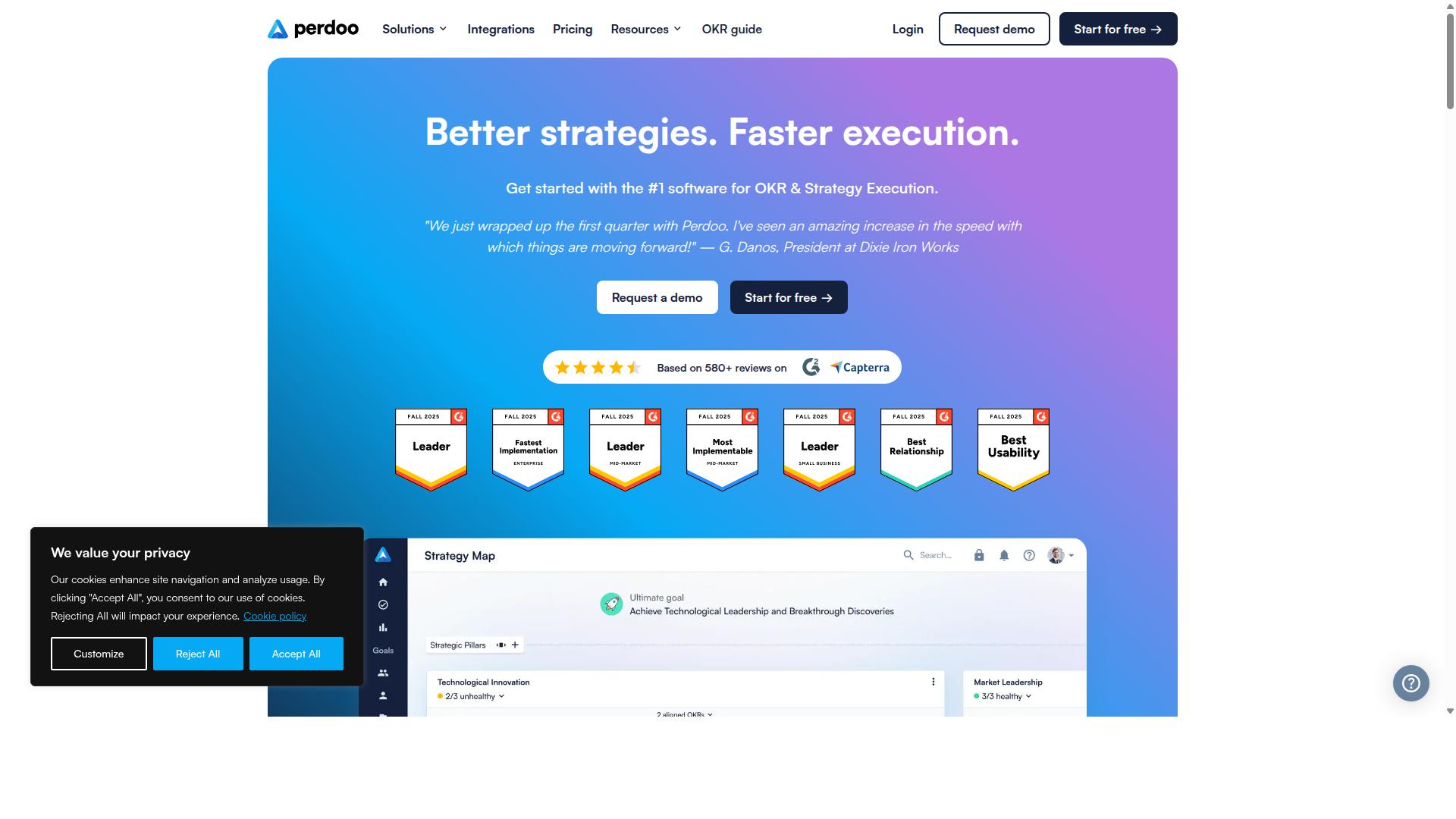
Perdoo specializes in OKR (Objectives and Key Results) management, helping organizations align their goals and track progress with precision. It positions itself as a strategy execution platform that brings strategy, goals, and performance together in one place. Teams that are serious about the OKR methodology often find this focus refreshing.
The platform covers the essentials: setting direction, aligning teams, tracking KPIs and OKRs, and reporting on progress. It also includes a strategy map and initiative tracking, which helps leaders see how daily work connects to larger company objectives. For organizations that want a single strategic framework, Perdoo consolidates what might otherwise live in multiple tools.
Where Perdoo is more limited is in broader HR functionality. It may lack some of the performance review tools, pulse surveys, or employee recognition features that come with a full employee experience platform. Teams looking for a complete people operations suite might need to pair Perdoo with other software.
One practical consideration is the pricing structure. Public reviews note a 10-seat minimum on paid plans with per-user pricing around EUR8 per month, which can add up for larger teams. That said, for companies fully committing to OKRs, Perdoo's focused approach to goal management often outweighs these limitations. Visit Perdoo's website to see if its strategy-first model fits your team.
7. Betterworks
Betterworks is a continuous performance management platform that integrates goal setting with ongoing feedback and development, designed for agile organizations. The platform moves away from the traditional annual review cycle in favor of a more fluid approach to managing employee performance.
At its core, Betterworks focuses on aligning individual objectives with broader company priorities. This goal alignment helps teams understand how their daily work contributes to larger business outcomes, which can improve focus and motivation across the organization.
The platform supports continuous check-ins between managers and employees, replacing the once-a-year performance review with more frequent conversations. These regular touchpoints allow for timely course corrections and help managers stay aware of emerging challenges before they become larger issues.
Feedback tools within Betterworks enable peer-to-peer recognition and constructive input throughout the year. This ongoing feedback loop creates a culture where employees feel heard and supported, rather than waiting for a formal review period to discuss their progress.
For organizations focused on long-term workforce planning, Betterworks includes succession planning and career development capabilities. These tools help identify high-potential employees and map out growth paths, ensuring that key roles have qualified successors ready when needed.
Betterworks is generally positioned for enterprises looking for scalable solutions that can adapt to complex organizational structures. Larger companies with multiple departments and distributed teams often find this type of platform useful for maintaining alignment across the business.
Pricing and specific feature availability can vary based on organizational size and needs. For the most current information on plans and capabilities, checking Betterworks' website directly is recommended.
How to Choose the Right Option
With so many strong Workleap alternatives on the market, selecting the right one requires a systematic approach that aligns with your organization's specific HR and management needs. Jumping straight to pricing or feature lists without a clear framework often leads to buyer's remorse.
This section will help you match your needs to the right software by focusing on three core areas: company size, budget, and the specific HR challenges you are trying to solve. A tool that works for a 20-person startup may feel clunky for a 500-person enterprise, and vice versa.
Take a moment to think about your current pain points. Are you struggling with low engagement, inconsistent feedback, or a lack of goal alignment? The answers will guide every decision you make in the comparison process.
The following steps will give you a practical, actionable path forward. Use them to filter the Workleap competitors you have seen so far and land on a platform that fits your culture and your roadmap for growth.
Matching Features to Your HR and Management Needs
To choose wisely, list your top HR priorities-whether it's improving engagement, streamlining performance reviews, or aligning goals-and then match those to each platform's strengths. Start by writing down the three biggest frustrations your team faces today.
Next, create a feature checklist based on the core capabilities discussed earlier in this article. Common categories to consider include performance management tools, goal setting software, feedback tools, and employee recognition platforms. If your team relies on frequent check-ins, prioritize tools with strong continuous performance management features.
Use the comparison from this article to narrow down your options. For example, if you need the full spectrum from pulse surveys to manager check-ins, look for an employee experience platform that covers multiple use cases. If you only need one specific module, a specialized tool may be a better fit.
Take advantage of free trials to test the shortlist in real conditions. HeyRamp, for instance, offers a 14-day trial so you can evaluate its performance management, employee engagement, goal alignment, and team development capabilities with your own team. Ask your managers to test the workflow and see if it feels natural.
Finally, evaluate scalability and pricing. The best choice aligns with your team size and culture, not just your current headcount. Consider whether the platform can grow with you as you add employees, expand departments, or introduce new HR processes.
Research suggests that the most successful software adoptions happen when the tool matches the organization's maturity level. A lightweight solution may be perfect for a small team, while a larger organization may need deeper workforce analytics and talent management capabilities. Weigh your options carefully, and let your priorities, not the marketing hype, make the final call.
Final Verdict
After comparing the top Workleap alternatives, HeyRamp emerges as the best overall choice for its unbeatable combination of comprehensive features, transparent flat-fee pricing, and built-in training. The platform brings together employee engagement software, performance management tools, and workforce analytics into one cohesive system. That means teams can stop juggling multiple subscriptions and start working from a single source of truth.
HeyRamp is trusted by 20+ organizations and 400+ teams, which speaks to its reliability in real-world people operations. One flat fee pricing removes the guesswork that comes with per-seat models, making budgeting simpler for HR leaders. The built-in training and education also mean your managers get guidance without needing a separate learning management system.
What sets HeyRamp apart is how it combines personality insights with performance tools, giving managers instant coaching tips and automated reminders. Guided conversation templates help with difficult discussions, while aggregated people analytics dashboards surface trends across the organization. Automatic compliance documentation adds another layer of practical value for busy HR teams.
Other tools like Lattice and Culture Amp are excellent in their own right, particularly for organizations with deep specialization needs. However, for most teams looking at Workleap competitors, HeyRamp delivers the best value across the board. The all-in-one approach covers feedback tools, goal setting software, pulse surveys, and continuous performance management without forcing you to piece together a stack.
If you are evaluating employee experience platforms, the smartest next step is to experience HeyRamp directly. The free trial lets you explore the features firsthand and see whether the platform fits your team's workflow. Visit HeyRamp's website to start your trial and discover what a truly integrated HR software comparison winner feels like in practice.
Recommended Resources: